S&P500 Daily Action Areas & Price Targets 5/6/26

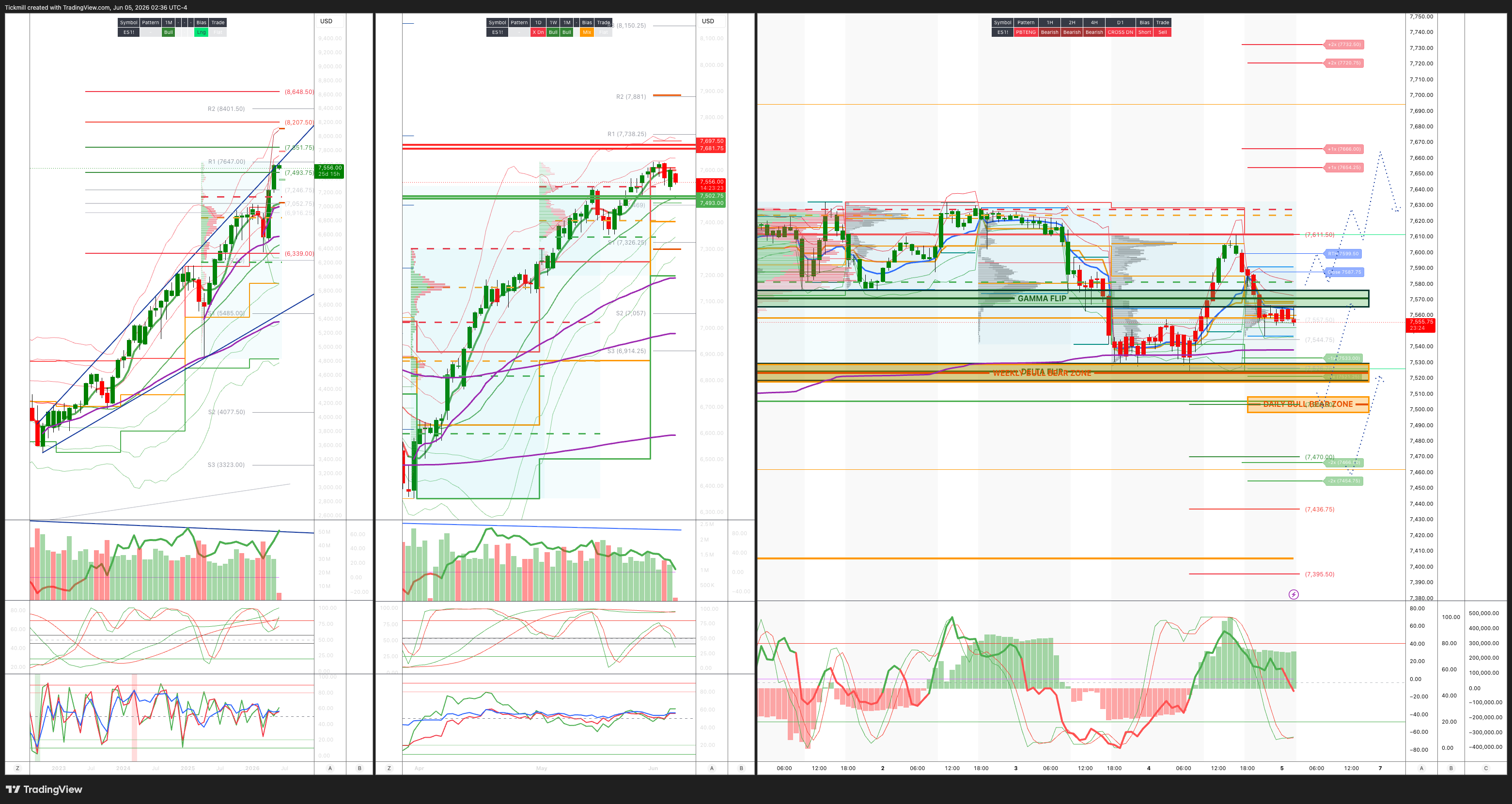
S&P500 Daily Action Areas & Price Targets 5/6/26
***QUOTING ES1! FOR CASH US500 EQUIVALENT LEVELS, SUBTRACT POINT DIFFERENCE***
WEEKLY BULL BEAR ZONE 7535/25
WEEKLY RANGE RES 7680 SUP 7500
June MOPEX Straddle: 274pt range implies a OPEX to OPEX range of [7134, 7683]
June QOPEX Straddle is 546.4pt giving us a range of [5960,7052]
JHEQX Q2 Collar 6189/6290 - 6865/6955
DEC2025 OPEX to DEC2026 OPEX is 945 points giving us a range of [5889,7779]
SPX PUT/CALL RATIO 1.09 (The numbers reflect options traded during the current session. A put-call ratio below 0.7 is generally considered bullish, and a put-call ratio above 1.0 is generally considered bearish)
DAILY VWAP BEARISH 7600
WEEKLY VWAP BULLISH 7480
MONTHLY VWAP BULLISH 7036
DAILY STRUCTURE - BALANCE 7562/7632
WEEKLY STRUCTURE – OTFH - 7515
MONTHLY STRUCTURE - OTFH - 7199
Balance: This refers to a market condition where prices move within a defined range, reflecting uncertainty as participants await further market-generated information. Our approach to balance includes favouring fade trades at the range extremes (highs/lows) while preparing for potential breakout scenarios if the balance shifts.
One-Time Framing Higher (OTFH): This represents a market trend where each successive bar forms a higher low, signalling a strong and consistent upward movement.
One-Time Framing Lower (OTFL): This describes a market trend where each successive bar forms a lower high, indicating a pronounced and steady downward movement.
DAILY BULL BEAR ZONE 7585/95
GAMMA FLIP 7571
DELTA FLIP 7525
DAILY RANGE RES 7654 SUP 7521
2 SIGMA RES 7720 SUP 7466
VIX BULL BEAR ZONE 19
TRADES & TARGETS
LONG ON REJECT/RECLAIM 7502 TARGET GAMMA 7571
***ADDITIONAL SETUPS & TARGETS HIGHLIGHTED ON THE CHARTS***
(I FADE TESTS OF 2 SIGMA LEVELS ESPECIALLY INTO THE FINAL HOUR OF THE NY CASH SESSION AS 90% OF THE TIME WHEN TESTED THE MARKET WILL CLOSE ABOVE OR BELOW THESE LEVELS)
GOLDMAN SACHS TRADING DESK VIEW - ‘Broadening’
US equities staged a notable broadening session, with the S&P 500 rising 41bps to 7,584 despite continued pressure in megacap Tech. The Nasdaq 100 fell 53bps to 30,407, while the Russell 2000 gained 149bps to 2,936 and the Dow rose 173bps to 51,561. The market-on-close skew was supportive at $1.6bn to buy. Volumes were a bit below the recent elevated run-rate at 18.7bn shares across US exchanges versus the YTD daily average of 19.1bn. Cross-asset conditions improved versus the prior day, with VIX down 461bps to 15.32, WTI crude down 309bps to $93.05, the 10-year yield down 2bps to 4.47%, DXY down 10bps to 99.43, gold up 101bps to 4,479, and Bitcoin continuing to weaken, down 244bps to 63,327.
The important feature of the session was that the market shrugged off early weakness from AVGO, which fell 12% after results failed to clear a very elevated setup. This is the second consecutive day where the index-level message was much better than the megacap or AI-hardware tape. Momentum was under pressure, and megacap supply has become a clear trend over the last two sessions, likely being used to fund other trades in the market, including the absorption of GOOGL’s record equity issuance and expectations for future issuance. The broader market’s ability to rally while Nasdaq fell is a constructive sign for breadth, but it also confirms that leadership is rotating away from the most crowded AI/momentum winners, at least tactically.
Weakness in Tech provided a tailwind to other parts of the market. Financials and Health Care were standouts, with Medtech particularly strong, and the 12-month loser universe also caught a bid. This is exactly the type of broadening that investors had been looking for, but it is happening through a funding rotation rather than a uniformly bullish expansion of risk appetite. Investors are selling or trimming parts of megacap Tech and AI momentum to buy laggards, cyclicals, Health Care, Financials, REITs, Industrials, Discretionary, and other under-owned groups. That can keep the S&P supported, but it also means factor volatility is likely to remain elevated.
The setup into payrolls is important. The desk estimates nonfarm payrolls rose 60k in May, below consensus of 85k and below the 92k whisper. Average hourly earnings are expected at 0.4% month over month, while the unemployment rate is expected to remain unchanged at 4.3%, in line with consensus. This is not a clean goldilocks forecast. A 60k payroll number is soft enough to raise some growth questions, and a 0.4% wage print would be firm enough to complicate the disinflation narrative. The market’s ideal outcome remains probably 70k to 100k jobs, stable unemployment, and wages of 0.2% to 0.3%. A 60k headline with 0.4% wages could revive stagflation concerns if rates or oil move higher in response.
Floor activity picked up to 7 out of 10, and the desk finished modestly skewed to buy at +161bps versus a 30-day average of +78bps. Asset managers finished slight net sellers, with supply in Tech, Financials, and Consumer, offset by demand in macro products and Communication Services. Hedge funds finished slight net buyers, driven by demand in Industrials, Discretionary, REITs, and Financials, offset by supply in Tech and macro products. This flow profile supports the broadening message. HFs are not simply adding broad beta; they are rotating out of Tech and macro products into sectors that lagged or benefit from a more equal-weight recovery.
The ECM calendar remains robust, with the desk active on INIO and LFTO debuts. This matters because equity supply remains a persistent background concern. The market has been able to absorb large offerings, including the record GOOGL transaction, but the absorption is not costless. Some of the megacap supply over the last two sessions likely reflects capital being freed up for new issuance and other trades. As long as buybacks, retail, and systematic flows remain supportive, issuance may not derail the market, but it can contribute to rotations and pressure the most liquid funding sources.
Post-bell earnings reinforced the dispersion theme. TTAN rose 15% after a beat and raise with accelerating top-line and GTV growth. The stock is now up roughly 60% in less than a month, showing that the market will still reward genuine acceleration and upward revisions, even outside the biggest AI hardware names. The company raised its FY guide to $1.130tn to $1.140tn from $1.110tn to $1.120tn, and the reaction suggests investors are still willing to chase strong growth stories where the numbers are improving.
LULU fell 9% after results came in below already low expectations. The bar was very low for 2Q, but the result was still below the lowest bogeys the desk had heard. The reaction is unlikely to create a rush to cover or FOMO to own the stock. This is important for Consumer because it shows that low expectations alone are not enough. Investors are willing to buy select housing-linked, value, and retail winners, but they are not broadly embracing discretionary names with deteriorating fundamentals. The group remains highly stock-specific.
Derivatives confirmed the broadening trade. AVGO vol saw put selling and risk reversals as favored expressions, suggesting investors were monetizing downside or positioning for stabilization rather than chasing further downside after the 12.5% move lower. More broadly, SPX broke from the recent spot/vol pattern and traded spot up, vol down, with front-end vols offered and skew relaxing. That is a healthier index-level pattern than the recent positive spot/vol correlation. Nasdaq retained its spot/vol correlation, however, and skew relaxed across both NDX and RUT.
Tomorrow’s S&P straddle is priced at just 47bps, which would make it the cheapest NFP straddle since December 2024. With the S&P at 7,584, that implies only about a 36-point move for payrolls, roughly a range of 7,548 to 7,620. The desk thinks this reflects how much S&P gamma has reset lower and likes owning it. That makes sense given the event risk: payrolls, wages, unemployment, oil, yields, tariffs, Middle East headlines, and a major rotation out of megacap Tech all remain live variables. A 47bp implied move looks low if the data surprise in either direction.
The desk also thinks IWM next-week calls screen cheap given the upcoming catalyst slate, potential geopolitical resolution, and the chance of continued broadening. That view aligns with today’s price action, where the Russell 2000 outperformed sharply while Nasdaq lagged. If the market continues to rotate away from crowded megacap Tech and into laggards, small caps could extend their catch-up, especially if yields do not rise materially after payrolls and if geopolitical risk eases. However, IWM remains sensitive to growth scares, funding stress, and higher real rates, so the payroll mix matters more for small caps than for megacap Tech.
Yesterday’s tape was constructive for breadth but less constructive for crowded AI/momentum leadership. The S&P rose despite Nasdaq weakness and a sharp AVGO drawdown, while Russell, Dow, Financials, Health Care, Medtech, and the 12-month loser universe all caught a bid. That is a healthier composition than a narrow megacap rally, but it is also being funded by Tech selling and comes ahead of an underpriced NFP event. The market wants a soft-but-not-too-soft payroll print with contained wages. If it gets that, the broadening trade can continue, with IWM, Financials, Health Care, Industrials, REITs, and select Discretionary likely to outperform. If payrolls are weak with hot wages, or hot enough to push yields higher, the choppy grind can quickly turn into a sharper factor unwind.
Disclaimer: The material provided is for information purposes only and should not be considered as investment advice. The views, information, or opinions expressed in the text belong solely to the author, and not to the author’s employer, organization, committee or other group or individual or company.
Past performance is not indicative of future results.
High Risk Warning: CFDs are complex instruments and come with a high risk of losing money rapidly due to leverage. 68% and 74% of retail investor accounts lose money when trading CFDs with Tickmill UK Ltd and Tickmill Europe Ltd respectively. You should consider whether you understand how CFDs work and whether you can afford to take the high risk of losing your money.
Futures and Options: Trading futures and options on margin carries a high degree of risk and may result in losses exceeding your initial investment. These products are not suitable for all investors. Ensure you fully understand the risks and take appropriate care to manage your risk.
Patrick has been involved in the financial markets for well over a decade as a self-educated professional trader and money manager. Flitting between the roles of market commentator, analyst and mentor, Patrick has improved the technical skills and psychological stance of literally hundreds of traders – coaching them to become savvy market operators!